
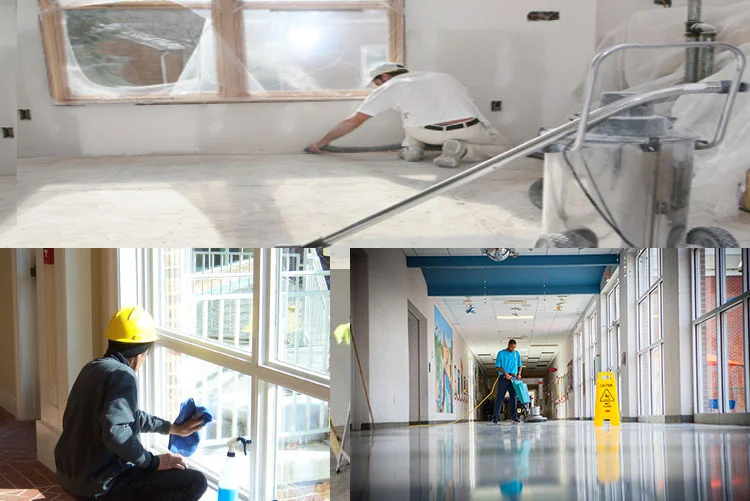

When the last subcontractor packs up their tools, a newly renovated space or newly constructed building may appear finished from across the room. Up close, it is rarely move-in ready. Construction inherently produces a stubborn, invasive residue of pulverized drywall, cured adhesive drips, microscopic silica dust, and grout haze that standard janitorial techniques cannot handle. Post-construction cleaning is not simply a deeper version of regular housekeeping; it is a specialized, multi-stage remediation process that bridges the gap between an active jobsite and a safe, functional occupancy.
Overlooking the technical nature of this turnover phase routinely leads to failed air quality inspections, scratched architectural glass, ruined HVAC components, and contentious handovers. Achieving a polished, move-in-ready result requires an understanding of building materials, specialized equipment, and a disciplined, phased execution strategy.
Understanding the Unique Challenges of the Post-Build Environment
Before deploying a cleaning crew, project managers and cleaning specialists must evaluate the specific physical and environmental obstacles unique to construction sites.
The most persistent issue is micro-fine particulate and settling dust. Operations like drywall sanding, masonry cutting, and carpentry generate microscopic particles that remain suspended in the air for days. Standard commercial vacuums lack the filtration needed to capture these particles, often blowing them right back into the room through exhaust ports. Furthermore, dust continues to settle for forty-eight to seventy-two hours after physical agitation on the site stops. Wiping down surfaces prematurely without an air stabilization plan simply invites a secondary layer of dust to settle within hours.
Another critical risk involves substrate sensitivity and chemical reactions. Modern architecture incorporates diverse, delicate finishes, from matte black hardware and low-iron glass to acid-sensitive natural stone and factory-sealed hardwood. Each material reacts differently to cleaning agents. Using an acidic wash to remove mortar haze can permanently etch marble or limestone. Similarly, aggressive scraping on tempered glass can dislodge manufacturing debris and leave permanent scratches across the pane.
Finally, trade overlap and compressed schedules frequently disrupt cleaning workflows. Cleaning crews often have to navigate active jobsites where electricians are installing final fixtures, painters are touching up trim, and carpet installers are finishing hallways. This overlap creates a frustrating cycle of cleaning, re-soiling, and re-cleaning, driving up labor costs and risking cross-contamination between finished and unfinished zones.
The Three-Phase Framework for Post-Construction Cleaning
Treating post-construction cleaning as a single marathon event almost guarantees missed areas, surface damage, and persistent dust. Professional cleaners divide the turnover into three distinct phases, each tied to specific project milestones.
Phase 1: The Rough Clean
The rough clean begins immediately after the framing, plumbing, mechanical, and electrical trades finish their primary installations. The focus here is strictly on bulk removal and structural clearing. Crews haul away discarded packaging, framing cutoffs, protective cardboard, and drywall scraps. Windows are cleared of manufacturer stickers and heavy overspray, and rough surfaces receive an initial vacuuming or sweeping using sweeping compounds to keep dust clouds down. The goal is to provide a safe, clear workspace so that finish trades—such as painters, tilers, and cabinet makers—can work cleanly and accurately.
Phase 2: The Deep Clean
The deep clean represents the most labor-intensive and technically demanding stage of the project. It takes place only after all trades have finished their work and all wet materials, like paint and grout, have fully cured. Every surface from ceiling to floor receives targeted attention:
-
Cabinets, closets, and drawers are wiped down inside and out, clearing the dust that routinely settles in hidden tracks and corners.
-
Window frames, sills, tracks, and panes undergo thorough mechanical and chemical cleaning to remove stickers, silicone smears, and drywall splatter.
-
Light fixtures, ceiling fans, HVAC diffusers, and smoke detectors are detailed to eliminate overhead dust reservoirs.
-
Bathrooms and kitchens receive full sanitization, with careful removal of grout haze, protective adhesives on appliances, and polishing of plumbing fixtures.
Phase 3: The Final Touch-Up Clean
Conducted twenty-four to forty-eight hours after the deep clean, the final pass accounts for airborne dust that has settled onto horizontal planes. This is a white-glove inspection sweep. Technicians wipe down countertops, polish mirrors, touch up architectural glass, remove any final fingerprints from doors and light switches, and perform a final HEPA vacuuming and damp mop of all flooring. Once this phase concludes, the space is ready for furniture delivery or municipal certificate of occupancy inspections.
Best Practices for Execution
To minimize labor, avoid costly surface damage, and deliver a pristine interior, cleaning professionals follow several non-negotiable operational principles.
Implement a Strict Top-Down, Back-to-Front Workflow
Gravity dictates cleaning efficiency. Always begin at the highest points in a space—ceiling beams, light fixtures, upper crown moldings, and high ductwork—and work progressively downward toward the floor. Similarly, work from the farthest interior corners of the building toward the primary exit. This systematic progression ensures that settled dust falls onto surfaces that have not yet been cleaned, preventing teams from having to re-clean finished zones.
Isolate and Protect the HVAC System
Running the building’s central heating and cooling system during post-construction cleaning can contaminate the entire ductwork network. Microscopic dust pulled into return vents coats the internal coils, exhausts into previously cleaned rooms, and degrades indoor air quality long after occupancy. Keep HVAC systems off or ensure all return vents are completely sealed with plastic sheeting during cleaning passes. Use standalone commercial air scrubbers equipped with HEPA filtration to clean the air, and only install the building’s permanent, high-efficiency filters after the final clean is complete.
Prioritize HEPA Filtration and Wet-Wiping Protocols
Dry sweeping and standard feather dusting simply relocate dust from one surface to another. Crews must rely on microfiber cloths, which possess a static charge that traps dust rather than launching it into the air. All vacuuming must be performed using commercial-grade vacuums equipped with certified HEPA filters capable of trapping particles down to 0.3 microns with 99.97 percent efficiency.
Match Chemistry to the Surface
There is no such thing as a universal cleaner on a construction site. Grout haze, silicone residue, and latex paint require distinct chemical solutions. Neutral-pH cleaners should be the default for stone and sensitive finishes, while specialized enzymatic or mild solvent cleaners should be reserved for specific adhesive removals. Before applying any chemical solution or mechanical scraper across a prominent surface, test it in an inconspicuous area to verify compatibility. When cleaning glass, avoid carbon steel razor blades; use composite or stainless blades paired with ample lubricating soapy water to prevent scratch damage.
The Handover and Final Verification
A successful post-construction cleaning project concludes with rigorous verification. Utilizing a detailed, room-by-room punch list allows site supervisors and clients to inspect surfaces systematically under proper lighting conditions. Natural raking light reveals surface dust, streaks, and scratches that overhead ambient lighting hides.
By treating post-construction cleaning as a disciplined technical trade rather than an afterthought, developers and facility managers protect their structural investments, safeguard indoor environmental health, and ensure that the finished space makes an immediate, high-quality impression.

Comments are closed.