
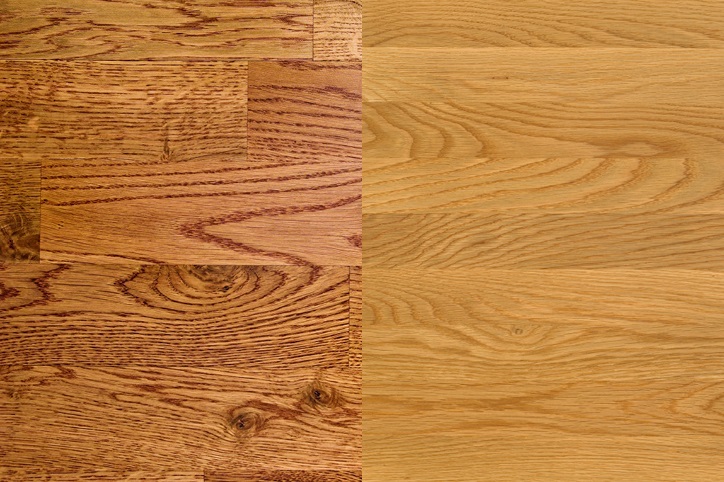

When selecting hardwood flooring, homeowners and designers frequently treat red oak and white oak as near-identical siblings. On a basic spec sheet, the comparison seems straightforward. Both are durable domestic hardwoods harvested across North American forests, both display prominent grain, and both share comparable Janka hardness ratings—1290 for red oak and 1360 for white oak. In the finishing bay, however, that perceived equivalence disappears.
Red oak and white oak respond to stains, sealers, and topcoats in fundamentally different ways. Beneath their milled surfaces lie distinct cellular anatomies, divergent baseline undertones, and radically different concentrations of organic chemistry. Attempting to apply the same finishing schedule to both species without accounting for these differences is one of the most reliable ways to end up with blotchy finishes, unexpected salmon undertones, or severe discoloration from chemical reactions.
Understanding how these two timbers absorb pigments and interact with modern finishes is essential for achieving a clean, predictable floor finish.
Anatomical Foundations: Grain, Porosity, and Undertones
Before a single drop of stain touches raw wood, the species’ native coloration and physical grain structure establish the boundary conditions of the project.
Despite its name, raw white oak is rarely white. Its raw lumber spans a spectrum of pale wheat, muted taupe, and cool olive-gray. Its cellular structure is dense, with medullary rays—the ribbon-like cells that radiate perpendicular to the growth rings—running long and prominent. Crucially, the vascular pores in white oak’s heartwood are plugged with tyloses, balloon-like cellular outgrowths that make the timber virtually impervious to water penetration. This natural barrier is why white oak has historically been favored for shipbuilding and whiskey barrels, and it gives the wood a tighter, more uniform surface when sanded.
Red oak exhibits an entirely different anatomy. The wood displays an unmistakable warm palette, ranging from pale cream to deep salmon, copper, and rose. Its cellular pores are wide open and cavernous, entirely devoid of tyloses. If you cut a short dowel of red oak and submerge one end in water, you can physically blow air bubbles through the open tubular grain.
This cellular openness translates to dramatic, sweeping cathedral patterns across plain-sawn boards. More importantly, it creates capillary action that drinks up liquid stains at an accelerated rate compared to the tight, resistant pores of white oak.
How Stain Colors Behave Across Both Species
Because stains are semi-transparent color washes rather than opaque paints, the final appearance of a stained board is a subtractive color blend between the pigment and the underlying wood fiber.
The Ultra-Pale and Natural Scandinavian Aesthetic
The contemporary demand for ultra-matte, raw-wood, and pale Nordic aesthetics has created a clear preference for white oak. Because white oak has a cool, neutral undertone devoid of strong pinks, clear waterborne finishes or white-pigmented penetrating oils preserve its pale wheat character without shifting color.
Achieving that same pale, raw look on red oak is notoriously difficult. A clear sealer applied to raw red oak activates the wood’s inherent carmine and peach pigments, often causing the floor to flash an unwanted fleshy, orange tint. To achieve a true neutral blonde on red oak, finishers must first suppress those red tones. This typically requires applying a green-tinted neutralizing stain—since green sits opposite red on the color wheel—or treating the raw wood with a two-part chemical bleach composed of sodium hydroxide and hydrogen peroxide before staining.
Medium Tones and Weathered Grays
Muted gray and complex taupe stains reveal another sharp divide between the species. On white oak, gray stains sit naturally over the timber’s cool brown and olive base, producing clean, sophisticated charcoal and weathered-driftwood tones.
On red oak, cool gray stains frequently produce muddy or faintly purple results. The underlying pink fiber fights against the cool gray pigment, creating visual dissonance across the floorboards. Medium walnut stains, however, perform exceptionally well on red oak. The wood’s natural warmth lends a rich, fiery depth to medium browns, creating traditional warmth that can sometimes look flat or sterile on denser white oak.
Deep Espresso and Ebony
For dark, dramatic floors, red oak’s open vascular pores become an asset. The large, hollow springwood tubes absorb dark pigments voraciously, turning the grain lines into bold, inky black accents.
White oak takes dark stain just as effectively, but because its cellular pores are plugged with tyloses, the pigment deposits more evenly across the earlywood and latewood. The result is a more uniform, monochromatic dark floor with subdued grain definition.
The Chemistry of Tannin Pull
While selecting the right pigment is largely an aesthetic challenge, managing tannin pull is a strict chemical discipline unique to working with white oak.
Tannins, or tannic acids, are naturally occurring, water-soluble polyphenols found within the plant kingdom. Trees produce them as an evolutionary defense mechanism against fungal decay and boring insects. While red oak contains modest trace levels of tannins, white oak contains exceptionally high concentrations within its heartwood cells.
Tannic acid poses no threat when paired with traditional solvent-based finishes, such as oil-modified polyurethanes or mineral-spirit stains, because tannins do not dissolve in petroleum solvents. The issue arises with modern waterborne sealers and topcoats.
When a contractor applies a waterborne sealer directly to bare white oak, the water in the finish penetrates the wood surface and immediately dissolves the water-soluble tannins. As the water evaporates upward through the drying finish film, it carries the dissolved tannins with it via capillary action.
Once deposited at the surface of the curing film, the concentrated tannic acid oxidizes upon contact with ambient air. The result is an immediate, unsightly reaction known as tannin pull or tannin bleed:
-
Pale finishes develop splotchy, mustard-yellow or amber discoloration.
-
Greenish-black rings or blotches appear where puddling or uneven film thickness occurred.
-
Natural wood grain displays erratic, mottled patches instead of a clean, translucent tone.
Tannin pull is not a sanding defect or a problem with the durability of the protective film; it is a permanent chemical staining of the finish itself. Once a topcoat dries with severe tannin pull, the only remediation is sanding the floor back down to bare wood and starting over.
Best Practices for Prevention and Finishing
Preventing finishing failures on oak floors requires matching application techniques and chemistry directly to the timber species on the jobsite.
Dedicated Tannin-Blocking Primers
The golden rule of finishing white oak with waterborne products is simple: never allow water to make uninhibited contact with bare wood fibers.
Before applying a waterborne topcoat to white oak, installers must lay down an application-specific tannin-blocking sealer. These specialized basecoats typically rely on rapid-drying solvent carriers, dewaxed shellac formulations, or specially modified acrylic resins engineered to lock tannic acid deep inside the wood cells before the water carrier can mobilize it. Once this barrier cures, standard waterborne polyurethanes can be layered over the top without risk of yellowing.
Managing the Water-Popping Process
Installers often practice water-popping—lightly misting a sanded floor with water to open the grain before applying oil-based stains. Water-popping relaxes wood cells crushed by hard-plate sanding, allowing the wood to accept stain deeply and uniformly.
While water-popping works reliably on red oak, applying it to white oak requires strict discipline. If the wood is flooded or unevenly soaked, the water will draw tannic acids to the surface before the stain is even wiped. If water-popping white oak, technicians must use a calibrated, fine-mist pump sprayer, distribute the moisture with a microfiber pad, and allow the floor to dry completely before applying stain.
Capitalizing on Natural Tannins
The elevated tannin content in white oak is not always a liability; it can also be leveraged for striking architectural finishes.
Techniques such as ammonia fuming or applying reactive iron-acetate washes do not coat the surface with pigments. Instead, they interact chemically with the tannins inside the wood. Iron acetate binds with tannic acid to turn white oak a deep, silvery charcoal-black that penetrates beneath the surface without obscuring the grain. Because red oak lacks high tannin levels, these same reactive treatments yield only a weak, mottled brown.
Choosing the Right Substrate
Selecting between red and white oak should never be an afterthought left to chance or showroom availability. If your design vision calls for pale, Scandinavian neutrals, washed grays, wire-brushed textures, or fumed reactive treatments, white oak is the superior canvas, provided you respect its chemical sensitivities with proper tannin-blocking sealers.
If your goal is a classic, warm brown, an amber-toned traditional finish, or a deeply contrasting dark stain where sweeping grain patterns take center stage, red oak delivers reliable, beautiful results at an accessible price point. Aligning your finish schedule with the unique anatomy and chemistry of the timber ensures a resilient, visually balanced floor that wears its finish with confidence for decades.

Comments are closed.