
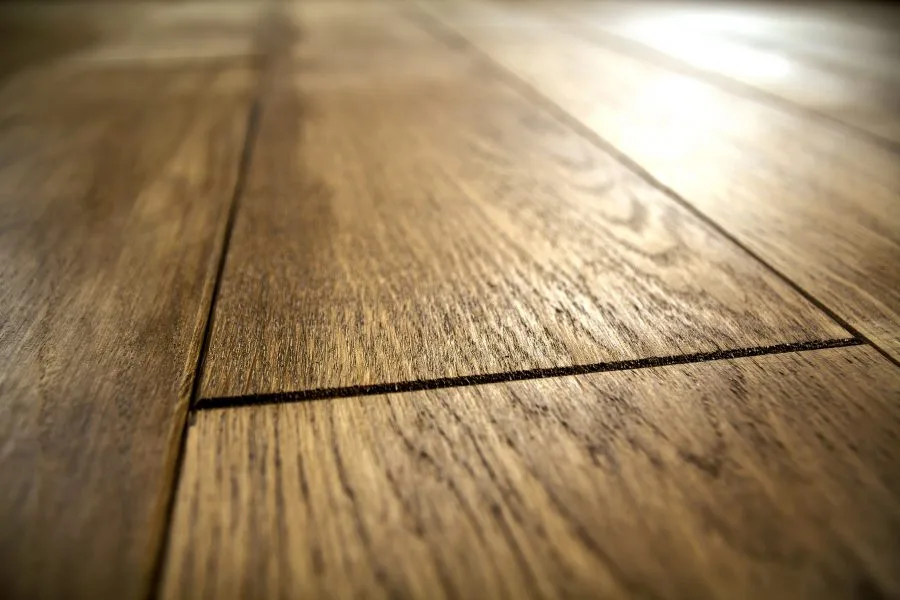

Even decades after it has been harvested, milled, and finished, solid hardwood behaves less like an inert building component and more like a dense, fibrous sponge. It continuously exchanges water vapor with its surrounding environment, expanding as it takes on moisture and contracting as it dries out. When that exchange happens uniformly across the entire thickness of a floorboard, the floor simply breathes with the seasons, showing subtle, harmless hairline gaps in dry winter months and tightening back up during humid summers.
Trouble begins when that balance breaks down. When one side of a solid plank absorbs or expels moisture faster than the other, internal hydraulic tension twists the wood out of shape. The two most common and destructive manifestations of this imbalance are cupping and crowning. While both conditions produce an uneven, rippling floor under raking light, they tell completely different stories about where moisture is traveling through the building envelope. Misdiagnosing the difference routinely leads to botched repairs, destroyed floors, and thousands of dollars in wasted labor.
The Mechanics of Moisture Gradients in Solid Planks
To accurately diagnose a deformed floor, one must understand how moisture moves through cellular timber. Wood reaches an equilibrium moisture content, or EMC, based on the ambient temperature and relative humidity of the air around it. In an ideal indoor environment maintained at 60 to 80 degrees Fahrenheit and 30 to 50 percent relative humidity, residential hardwood typically settles at an internal moisture content between 6 and 9 percent.
Deformation occurs when a vertical moisture gradient develops across the cross-section of the plank. Because solid planks expand primarily across their width rather than their length, differential swelling between the top surface and the bottom face generates severe physical distortion:
-
When the bottom of the board contains significantly more moisture than the top, the underside expands while the surface remains constricted, forcing the board into a concave profile.
-
When the top surface absorbs substantially more moisture than the underside, the surface expands while the bottom holds firm, forcing the board into a convex shape.
The greater the delta in moisture content between the top third and the bottom third of the plank, the more severe the physical deflection.
Diagnosing Cupped Hardwood: Symptoms and Primary Culprits
A cupped floorboard exhibits elevated edges and a depressed center. If you slide a straightedge across the width of a single plank, light will show through underneath the center, while the outer shoulders make firm contact with the ruler. In severe cases, the board seams press against one another with such force that the edges begin to crush and splinter.
Cupping occurs when the underside of the floorboard has a higher moisture content than the exposed surface. The floor is acting as a conduit, venting moisture from a damp subfloor system out into a drier living space.
The Subfloor Moisture Trap
In residential construction, the vast majority of cupping failures originate beneath the floor. In homes built over crawlspaces or unconditioned basements, excess earth dampness routinely migrates upward through wooden joists and subflooring panels. If a crawlspace lacks an intact, sealed 6-mil polyethylene vapor barrier across the ground, or if exterior foundation vents admit hot, humid outdoor air into a cool crawlspace, ground moisture will evaporate directly into the subfloor. As that moisture hits the bottom of the hardwood, the planks expand from below, driving the edges upward.
A similar dynamic unfolds over concrete slabs. If an installer secures a plywood subfloor or glues solid hardwood directly to a slab without a continuous, rated moisture vapor barrier, moisture vapor emissions from the concrete will steadily permeate the bottom of the boards.
Rapid Overhead Desiccation
While bottom-up moisture intrusion is the standard culprit, cupping can also be triggered from above. During harsh winter months, forced-air heating systems can plummet indoor relative humidity down to 15 or 20 percent. If the subfloor retains moderate moisture while the heated, ultra-dry room air rapidly pulls water out of the upper face of the boards, the exposed surface shrinks aggressively. The resulting tension pulls the edges upward, creating the classic cupped profile even though the subfloor itself is not abnormally wet.
The Anatomy of Crowning: The Critical Distinction
Crowning presents the exact physical opposite of cupping: the center of the board rises into a noticeable hump, while the outer seams sit low. Running a straightedge across a crowned board creates a rocking motion over the high central ridge.
True crowning caused purely by environmental conditions is relatively uncommon. It occurs when the exposed top face of the board absorbs significantly more moisture than the underside. This can happen after a localized plumbing flood, prolonged exposure to direct rain through open windows, or aggressive wet-mopping practices that saturate the upper wood fibers while the subfloor remains dry.
However, in the field, true environmental crowning accounts for only a fraction of cases. The vast majority of crowned floors are human-made, resulting from the single most catastrophic error a floor technician can make: premature sanding.
The Sanding Trap
When an inexperienced contractor or an impatient homeowner encounters a severely cupped floor, their initial reaction is often to bring in a heavy drum sander to grind the floor flat.
This is a critical mistake. If a contractor sands the high edges off a cupped floor while the bottom of the boards remains wet, they are shaving material off an unnaturally distorted board. Eventually, the underlying moisture issue is identified and resolved, whether through drying equipment, crawlspace encapsulation, or seasonal stabilization.
As the bottom of the plank loses its excess water and dries down to equilibrium, the bottom shrinks back to its original width. But because the outer edges were physically ground off during the cupped state, the equalized board now lacks its original shoulder mass. The board flattens out at its base, leaving the untouched center protruding as an uncorrectable crown. Once a floor has been crowned by premature sanding, the wood profile is permanently compromised, and the floor often must be torn out and replaced.
Diagnostic Field Protocols
Accurate diagnosis requires moving past visual inspection and gathering precise instrument data. Every forensic assessment should follow a systematic measurement protocol.
Pin-Type vs. Pinless Moisture Meters
Surface-reading pinless meters utilize electromagnetic sensor pads to scan boards quickly, which helps map the geographic boundaries of a moisture event. However, pinless meters provide an average reading through their depth of signal and cannot distinguish between moisture on the top of the plank and moisture on the bottom.
To diagnose a vertical gradient, technicians must use a pin-type resistance meter with insulated slide-hammer probes. Because the shank of each pin is coated in an electrical insulator, the meter reads electrical resistance only at the uninsulated tips. By driving the pins to a depth of one-quarter of the board thickness and recording the moisture level, then driving them deeper to three-quarters depth near the subfloor interface, an investigator can pinpoint the exact moisture gradient.
-
A reading that shows 8 percent moisture near the top and 14 percent near the bottom confirms active subfloor-driven cupping.
-
A reading showing 13 percent at the top and 8 percent at the bottom points to surface saturation or top-down humidity spikes.
Environmental Auditing
Moisture content readings inside the wood mean little without ambient context. Use a calibrated thermo-hygrometer to record the indoor temperature and relative humidity, calculating the ambient EMC.
Next, inspect the boundary conditions. Measure the moisture content of the subfloor from underneath if a crawlspace or basement is accessible. Check the humidity of the crawlspace air, inspect foundation grade lines for negative drainage toward the house, check HVAC condensate lines for hidden clogs, and look for plumbing lines routed directly beneath the distorted flooring.
Remediation: Why Patience Beats the Drum Sander
Once a diagnostic assessment is complete, the immediate imperative is to enforce absolute patience. Sanding machinery should remain off the jobsite until the environmental and wood readings have stabilized for weeks.
Eliminate the Moisture Reservoir
If bottom-up moisture is driving the issue, the source must be sealed. In crawlspaces, this means laying down an uninterrupted vapor retarder with sealed seams, conditioning the space, or repairing foundation perimeter drainage. In basements, it requires resolving foundation wall leaks and running commercial-grade dehumidification. If the issue is dry-air cupping, homeowners must introduce whole-home humidification to bring the ambient air back to a baseline of 35 to 45 percent relative humidity.
Controlled Drying
Once the intrusion is resolved, use high-velocity air movers and low-grain refrigerant dehumidifiers to pull excess moisture out of the building. In severe situations, specialized injection-drying systems or suction mats can be sealed directly over the floorboards to pull vapor up through the grain.
This process cannot be rushed. Forcing a floor to dry too quickly can cause cellular collapse and internal ring separation, known as shake. Depending on timber species, thickness, and ambient conditions, drying a subfloor system back to baseline EMC typically takes several weeks to several months.
Assessing Permanent Compression Set
Once the vertical moisture gradient equalizes—meaning the top and bottom of the plank measure within one to two percent moisture content of each other—one of two outcomes will occur:
-
Elastic Recovery: If the wood cells were not subjected to extreme mechanical crushing during their swollen state, the planks will relax completely flat on their own, requiring no sanding or refinishing whatsoever.
-
Permanent Compression Set: If the planks expanded against rigid boundaries and crushed their internal cellular walls, the wood fibers suffer permanent plastic deformation. When the wood finally dries out, the crushed fibers cannot return to their original volume, leaving noticeable gaps between the boards or a lingering ripple.
Only after the floor has fully dried and reached stable equilibrium should an installer evaluate residual deformation. If a light wave remains after months of stable moisture readings, the floor can then be safely sanded and refinished.
By treating cupping and crowning as mechanical symptoms of moisture physics rather than superficial flaws, flooring professionals and property managers can diagnose failures accurately, protect structural investments, and restore damaged hardwood to lasting stability.

Comments are closed.