
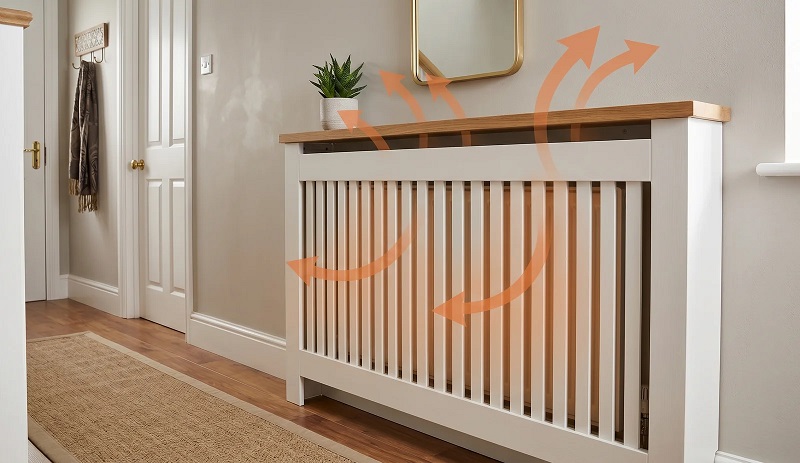

Vintage cast-iron radiators are architectural workhorses. Found across pre-war apartments, historic brownstones, and century-old bungalows, they provide quiet, reliable, and comfortable warmth through the dead of winter. Unfortunately, they rarely age with grace. Decades of thick, poorly applied paint, rusted relief valves, and heavy industrial proportions often turn these heating units into visual anchors that disrupt an otherwise curated room.
The natural instinct for many homeowners is to box the offending unit inside a solid cabinet, push a deep sofa against it, or drape it in heavy textiles. Doing so, however, turns an aesthetic problem into a heating disaster. Radiators depend on straightforward thermodynamics to warm a room. Concealing one without respecting those principles traps the heat where nobody can feel it, strains the heating system, and leaves your living space chilly.
Transforming an unsightly heating unit requires an approach that treats airflow as a primary design parameter. By understanding how thermal energy moves through a room, you can deploy disguises that satisfy your interior standards while preserving every unit of heat you pay for.
The Thermodynamics of the Radiator Loop
Despite their name, residential radiators do not rely solely on thermal radiation. They operate through two distinct thermodynamic mechanisms: radiant heat and convection currents.
Radiant heat travels via infrared electromagnetic waves, warming solid objects directly within its immediate line of sight. Convection, however, does the heavy lifting when it comes to circulating warmth throughout the entire volume of a room. A radiator draws cold, dense air off the floor into the spaces between its vertical columns or fins. As that air heats up, it expands, loses density, and rises toward the ceiling. As it reaches the upper room, it displaces cooler air, which drops to the opposite side of the room, drifts along the floor back toward the radiator, and starts the cycle again.
When you seal a radiator inside a solid wooden cabinet or cover it with tight obstructions, you sever this convective loop. Warm air pools underneath the top slab of the enclosure, baking the wood and wall cavity while the center of your living space remains cold. Any successful disguise must ensure two non-negotiable clearances: an unobstructed intake zone at floor level and an open exit path for rising heat at the top.
Engineered Radiator Cabinets: Balancing Opacity and Airflow
The most common disguise is a bespoke or modular radiator cabinet. Done poorly, a cabinet acts like an insulated cooler. Done correctly, it behaves like an architectural plenum that actually accelerates convective circulation into the living space.
The Mathematics of Perforation
If you want to enclose a radiator behind decorative paneling, the front face must offer adequate open area. A solid panel with a handful of drilled holes will not work. As a general benchmark, your front panel should maintain at least fifty to sixty percent open surface area.
Woven natural cane webbing, perforated aluminum sheets with architectural geometric patterns, and horizontal hardwood slats with generous spacing all provide the necessary breathability. Natural cane and metal grilles are particularly effective because they obscure the peeling cast iron beneath while presenting virtually no resistance to radiant heat or air currents.
Intake, Exhaust, and Heat Deflectors
A high-performance cabinet needs more than just a breathable face. It requires deliberate structural ventilation:
-
Floor Gap: The base of the cabinet must sit elevated off the floor by at least two to three inches, allowing cold room air to enter the convective chamber effortlessly.
-
Top Ventilation: The top surface should never be a continuous solid slab. Incorporating routed slots, a secondary metal grille, or an open reveal along the back edge allows hot air to escape freely toward the ceiling.
-
Internal Deflectors: Inside the cabinet, install a curved sheet metal deflector anchored to the rear wall just above the radiator columns, sweeping forward toward the front grille. This simple addition prevents rising hot air from stagnating beneath the top shelf and directs it outward into the room.
Floating Consoles and Open-Frame Shelving
If your room cannot afford the visual weight or footprint of a full cabinet, enclosing the unit is unnecessary. You can alter the visual perception of the space through intentional framing.
A deep floating shelf mounted four to six inches above the top of the radiator creates a functional mantel that visually anchors the wall. By selecting a thick slab of rift-sawn oak, reclaimed heart pine, or polished stone, you draw the eye upward toward decorative objects, framed art, or layered ceramics. The open air gap below the shelf ensures that convective air currents rise without interference, while the shelf itself deflects hot air into the room before it reaches the ceiling.
For an even simpler solution, place a leggy console table over the radiator. Choose an open-frame table with slender metal or turned-wood legs and no lower drawers or shelves. The table frames the heating unit like an intentional niche, allowing complete air circulation around the cast iron while giving you a usable surface for table lamps, books, and plants that tolerate dry, warm air.
The Monochromatic Paint Strategy
In narrow hallways, small powder rooms, or tightly configured bedrooms, adding furniture or millwork over a radiator steals valuable square footage. In these spaces, the most sophisticated design choice is to stop hiding the radiator and start camouflaging it through color.
Standard interior latex wall paint should never be applied to a radiator. Under the extreme temperature swings of steam or hydronic heat, latex dries out, cracks, chalks, and emits unpleasant chemical fumes. Instead, thoroughly scrape away loose, flaking layers of old finish, sand the iron down to a sound substrate, and apply a dedicated high-temperature metal enamel.
Rather than painting the unit contrasting white, match the radiator precisely to your wall color. When the radiator, baseboards, and walls share a single, unbroken hue—whether a warm off-white, a muted sage, or an inky charcoal—the radiator’s visual boundaries soften. Its industrial silhouettes blend directly into the plane of the wall, allowing other furnishings in the room to command attention.
Safeguarding Critical Mechanical Controls
Regardless of the disguise you choose, remember that a radiator is an active plumbing fixture that requires regular maintenance. A design that looks beautiful in October can become an emergency in January if a valve begins hissing or leaking.
Always preserve direct physical access to the supply valve, steam trap, and air bleed vent. If your system relies on a thermostatic radiator valve (TRV) to regulate temperature based on ambient room heat, enclosing that valve inside a cabinet will cause the sensor to misread trapped hot air as room warmth, prematurely shutting off your heat. When building an enclosure around a TRV-equipped unit, choose a model with a remote sensor or ensure the valve head sits entirely outside the cabinet perimeter.
Finally, install a foil-backed radiant barrier directly against the wall behind the radiator. Uninsulated exterior walls absorb an immense amount of radiant energy, transferring that heat directly outdoors. A clean reflective panel bounces that energy back into the living space, ensuring that your newly disguised heating system delivers every bit of comfort it was built to provide.

Comments are closed.